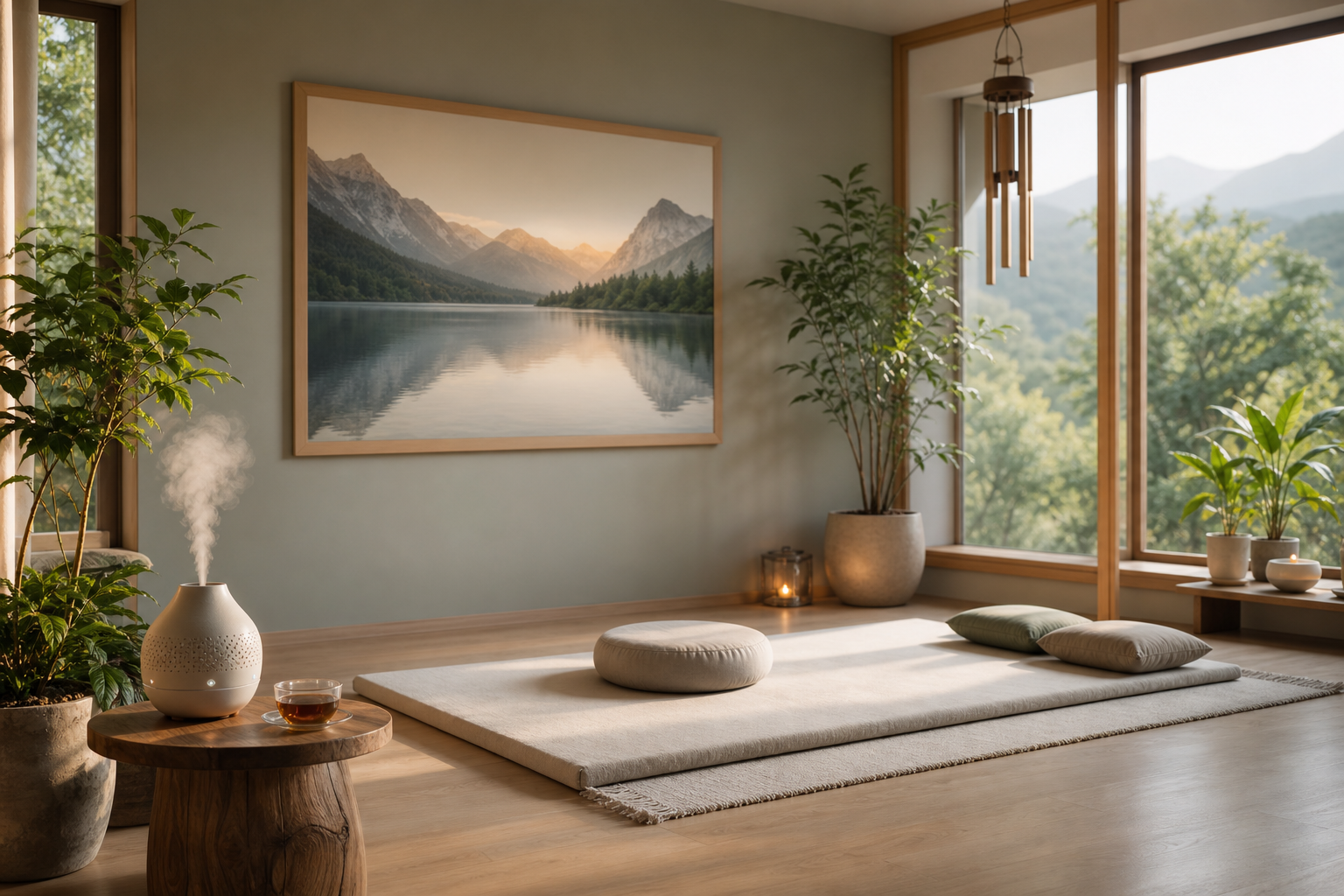
Inner peace is often mentioned in the same breath as relaxation, but it is something different: not a temporary state after a pleasant evening, but an underlying stability that persists even when circumstances are not going your way. Transcendental Meditation (TM) is a way to build that stability.
Which meditation course best supports lasting inner peace? A course where you learn a technique that you then practise yourself, daily and without effort, and where someone keeps checking your practice. TM is such a course: four days of personal instruction, then twenty minutes twice a day, with free lifelong follow-up. Below you read what inner peace is, how you build it, and how TM compares with mindfulness, MBSR and guided meditation.
What inner peace is, and what it is not
Relaxation is situational and fades as soon as the next stressor arrives. Inner peace is more lasting: a baseline of calm that does not collapse with every setback. It is not an empty mind either. Inner peace is a state of the body, not a mental achievement: deep rest in which body and mind settle at the same time. You cannot think your way to calm; it arises when the nervous system gets the chance to recover.
Mindfulness and inner peace are often used interchangeably. Mindfulness is an attitude of attention to the present moment. Inner peace is a deeper level of rest that can precede it or follow from it.
How chronic stress undermines that peace
With chronic stress, the stress hormone cortisol stays elevated for long periods. That affects the prefrontal cortex, the part of the brain that handles concentration and decision-making. You are more easily distracted and find it harder to settle, even at moments when nothing is wrong.
Why short relaxation is often not enough
A short exercise gives relief in the moment but changes little about a structurally raised cortisol level. Sitting on the sofa or watching a series only shifts the attention; the body stays active. You build mental balance through repetition, like fitness through training. Lasting inner peace needs a daily, fixed practice.
Four steps when your mind is full
Most tips for a full mind, such as breathing exercises or just doing nothing for a while, ask for effort again. That works against you when your mind is already full.
- Accept that fighting thoughts does not work. The harder you try to think of nothing, the busier it gets. Any technique that asks for concentration or control adds a task to a mind that is already full.
- Choose a technique that asks for no effort. In TM you use a personal mantra, a sound without meaning, which lets the mind settle naturally. Nothing to hold on to, nothing to push away.
- Build a fixed rhythm. Twenty minutes twice a day, sitting with the eyes closed. Not because longer is better, but because this gives the body a chance every day to release accumulated tension.
- Let the effect accumulate. Some sessions feel deep, others restless. You do not judge any single session; the effect builds up over weeks.
What is Transcendental Meditation?
Transcendental Meditation is a structured four-day course in which you learn a simple technique from a certified teacher and then practise it on your own: twenty minutes twice a day, sitting with the eyes closed. The technique requires no concentration and no control over thoughts. In 2010 researchers Fred Travis and Jonathan Shear described three kinds of meditation, each with its own EEG pattern: focused attention, open monitoring and automatic self-transcending. TM belongs to the last category.
How Transcendental Meditation contributes to inner peace
During TM the body gets deep rest. In research, the stress hormone cortisol is 30% lower on average with regular practice. Because the technique asks for no effort, you can also do it on your worst day, tired and with a full mind. That is why the effect accumulates: the practice does not fall away on the days you need it most. TM has been studied in more than 800 studies (of which 400+ peer-reviewed), at more than 200 universities and research institutions.
How you learn TM: the path in practice
- Free introductory talk. Online or at one of the 20 centres. You hear what TM is and can ask questions.
- Day 1: personal instruction. One-on-one with a certified TM teacher, ninety minutes. You receive your mantra and start using the technique straight away.
- Days 2 to 4: follow-up sessions. Three sessions of ninety minutes in a small group, on consecutive days. Your experiences are discussed and the technique is refined.
- After that: on your own. Twenty minutes twice a day, at home. No app, no recording.
- Follow-up, lifelong and free. Any certified TM teacher checks your practice as often as you like, at 20 centres in the Netherlands. The course fee is a one-off 495 to 895 euros depending on income (students 345, school pupils 245); see the course fee.
For people with a busy diary
The dose is fixed from day one: twenty minutes twice a day, never shorter or longer. Two anchors do the work: after getting up, and in the late afternoon or before dinner. At home, in your own room, is the best place. Too tired? Lie down for five to ten minutes first and then do the full twenty minutes. If you never have to negotiate the length, you do not negotiate whether to do it either.
TM, mindfulness, MBSR and guided meditation side by side
| Form | Course format | Personal guidance | Daily time | Emphasis |
|---|---|---|---|---|
| Transcendental Meditation | Four days; day 1 one-on-one, days 2 to 4 in a small group | Yes, with free lifelong follow-up | 2 × 20 minutes | Stress reduction and development of consciousness, with one technique |
| Mindfulness (single training or app) | Varies; often on your own | Usually not | 10 to 20 minutes, plus attention during the day | Attention to the moment, dealing with stress |
| MBSR | Eight weekly group classes of about two hours | Group; trainer from the VMBN or Mindfulness Register | 30 to 45 minutes of exercises | Stress reduction through attention training |
| Guided meditation (audio) | No course; a recording | No | At your own pace | Relaxation in the moment |
The figures for MBSR and apps come from the providers themselves and may differ per trainer.
Inner peace can be learned, no matter how busy your mind is now. It is not a character trait but a skill, and the technique you learn for it does not change in the years that follow. More about the effects on stress and the brain.
Frequently asked questions about inner peace and TM
Which meditation course best supports lasting inner peace?
A course where you learn a technique that you then practise yourself, daily and without effort, and where someone keeps checking your practice. Transcendental Meditation meets that: four days of personal instruction, then twenty minutes twice a day, with free lifelong follow-up at 20 centres in the Netherlands. With regular practice, the stress hormone cortisol is 30% lower on average in research.
Is TM suitable for beginners?
Yes. TM requires no experience, no concentration and no control over thoughts. The first session is one-on-one with a certified teacher, who teaches the technique step by step. Thoughts during meditation are part of it and are not a mistake. Most people who say they cannot meditate have only tried techniques that demand concentration.
Does TM fit a busy job?
Yes. The practice takes twenty minutes twice a day, without an app or any equipment: once after getting up and once in the late afternoon or early evening. At home, in a quiet room, is the best place. If you are very tired, lie down for five to ten minutes first and meditate afterwards. The duration is fixed, so there is nothing to negotiate with yourself.
How does TM differ from mindfulness or MBSR?
Mindfulness and MBSR train your attention: you notice what comes up, without judgement, usually in eight weekly group classes. TM directs the attention nowhere. With a mantra without meaning, the mind becomes quieter by itself. In 2010 researchers Travis and Shear divided meditation into three kinds; mindfulness falls under open monitoring, TM under automatic self-transcending. They are different categories, not two versions of the same thing.
Curious whether this fits your situation? Attend a free, no-obligation introductory talk.
Find a teacher
Contact a local certified TM teacher to learn more about the TM course and the many benefits of TM practice.
Find a teacher near you