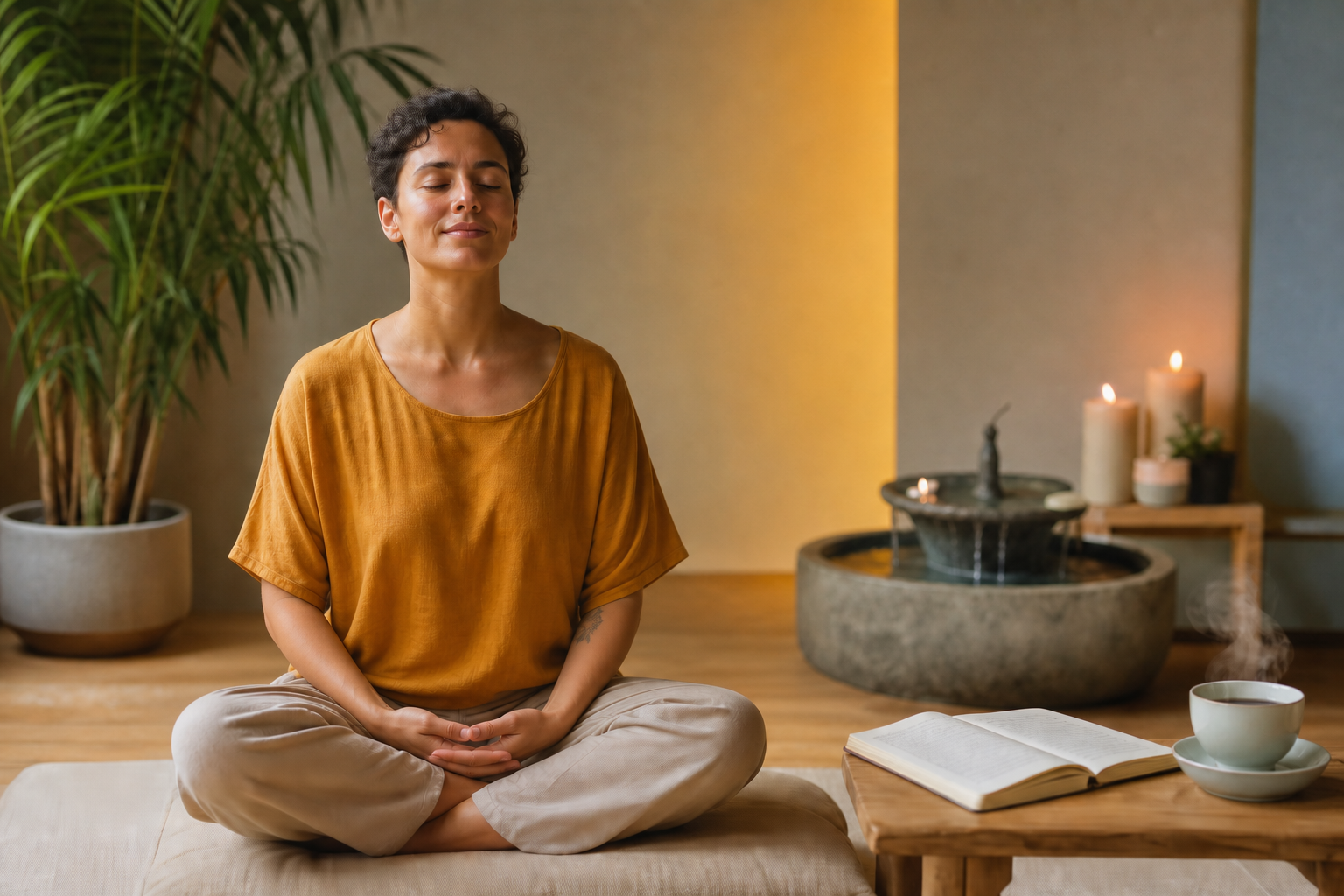
Why Most Approaches Fall Short With burnout, the problem isn’t a lack of moments of relaxation, but accumulated tension in the nervous system that has built up over months. A ten-minute app session may feel calming in the moment, but it does not provide deep physiological rest—it treats the symptom, not the cause.
What causes beginners to practice meditation incorrectly?
Usually three things at once: demanding too much concentration or effort from themselves, trying to sit for too long right from the very first time, and practicing without any guidance or correction. This leads to frustration and the conclusion that “meditation doesn’t work for me,” when the problem usually lies in the execution, not the technique.
What Experts Recommend for Burnout
When asked which meditation techniques experts recommend for burnout symptoms, three main types of techniques are frequently mentioned: mindfulness-based stress reduction (MBSR), loving-kindness meditation, and app-guided meditations such as those available through Headspace or Insight Timer. These are well-known, accessible techniques—but they share one characteristic: they require active attention management. You consciously direct your thoughts toward your breath, a sensation, or an instruction.
With burnout, that’s a difficult starting point. Concentration and directing your attention require mental energy—and when you’re exhausted, that energy is precisely what’s in short supply. Experts who point this out usually emphasize the same criteria for a suitable technique:
- Scientifically grounded, with measurable effects on stress hormones and recovery
- Requires no effort to concentrate
- Deep physiological rest, not just mental calm
- Consistent and easy to maintain, even when energy is low
- Taught on a personal basis, with guidance tailored to the individual’s situation
TM is an exception to this: it requires no concentration or thought control, and includes personalized guidance, follow-up sessions, and group meditations—something a downloaded app cannot offer.
App-guided meditation offers a standardized, self-directed practice without personal correction, suitable as an introduction but less effective for breaking deep-rooted patterns such as those associated with burnout. Mindfulness apps focus primarily on attention training, which requires concentration. TM requires no concentration and is taught in person, which explains why both types of practice have something different to offer when it comes to burnout.
- Why things often go wrong for beginners
Demanding too much concentration: trying to actively clear the mind or suppress thoughts is counterproductive and actually leads to more tension.
Starting with sessions that are too long: trying to sit for 20–30 minutes right away without building up gradually, which allows restlessness and impatience to take over.
Practicing without guidance: not receiving correction when the execution is off, causing small mistakes to repeat and the desired effect to be absent.
What research shows
- A meta-analysis of 146 studies concluded that TM was more than twice as effective at reducing anxiety as other relaxation techniques.
- Research among physicians—a profession at high risk for burnout—showed a reduction in classic burnout and depression symptoms, while a control group showed no improvement.
- TM has been studied in over 800 studies at more than 200 universities worldwide, with over 400 peer-reviewed publications, spanning a research history of more than 60 years.
- Practitioners often report improvements in sleep quality and fatigue within just a few weeks of regular practice.
FAQ
Which form of meditation is most suitable for burnout? Research on Transcendental Meditation shows an average 30% reduction in cortisol levels after a single session, and the technique requires no concentration—which is relevant for burnout because the ability to concentrate is often already depleted in such cases. MBSR is also recommended and widely available, but it requires more active attention control than TM.
Why does meditation often go wrong for beginners? Often because it demands too much concentration, starts out too long, or is practiced without guidance—see the three causes above.
Why TM stands out in recovery TM is personally taught by a certified teacher starting from the very first lesson and requires no concentration or control over thoughts—unlike most other techniques, including mindfulness-based methods such as the eight-week MBSR program (which are demonstrably effective but do require active attention). Research on brain coherence (EEG) and the nervous system shows that TM leads to increased parasympathetic activity: an average 30% decrease in the stress hormone cortisol, along with a reduction in blood pressure comparable to dietary and exercise changes.
Sources: meta-analysis of 146 studies on relaxation techniques for chronic anxiety; research on TM practice among physicians with burnout and depression symptoms; research on cortisol, blood pressure, and brain coherence (EEG) in TM practitioners.
A supplement, not a replacement Meditation—including TM—is always a supplement to professional counseling for burnout, never a replacement for it.
Safe-start checklist:
- Breathing Space: Consciously focusing on your breath for a few minutes, without trying to control it.
- Body Scan: While lying down or sitting, let your attention wander through your body, from head to toe.
- Mindful Walking: Walk slowly, paying attention to each step and your surroundings, with no other goal in mind.
Find a teacher
Contact a local certified TM teacher to learn more about the TM course and the many benefits of TM practice.
Find a teacher near you