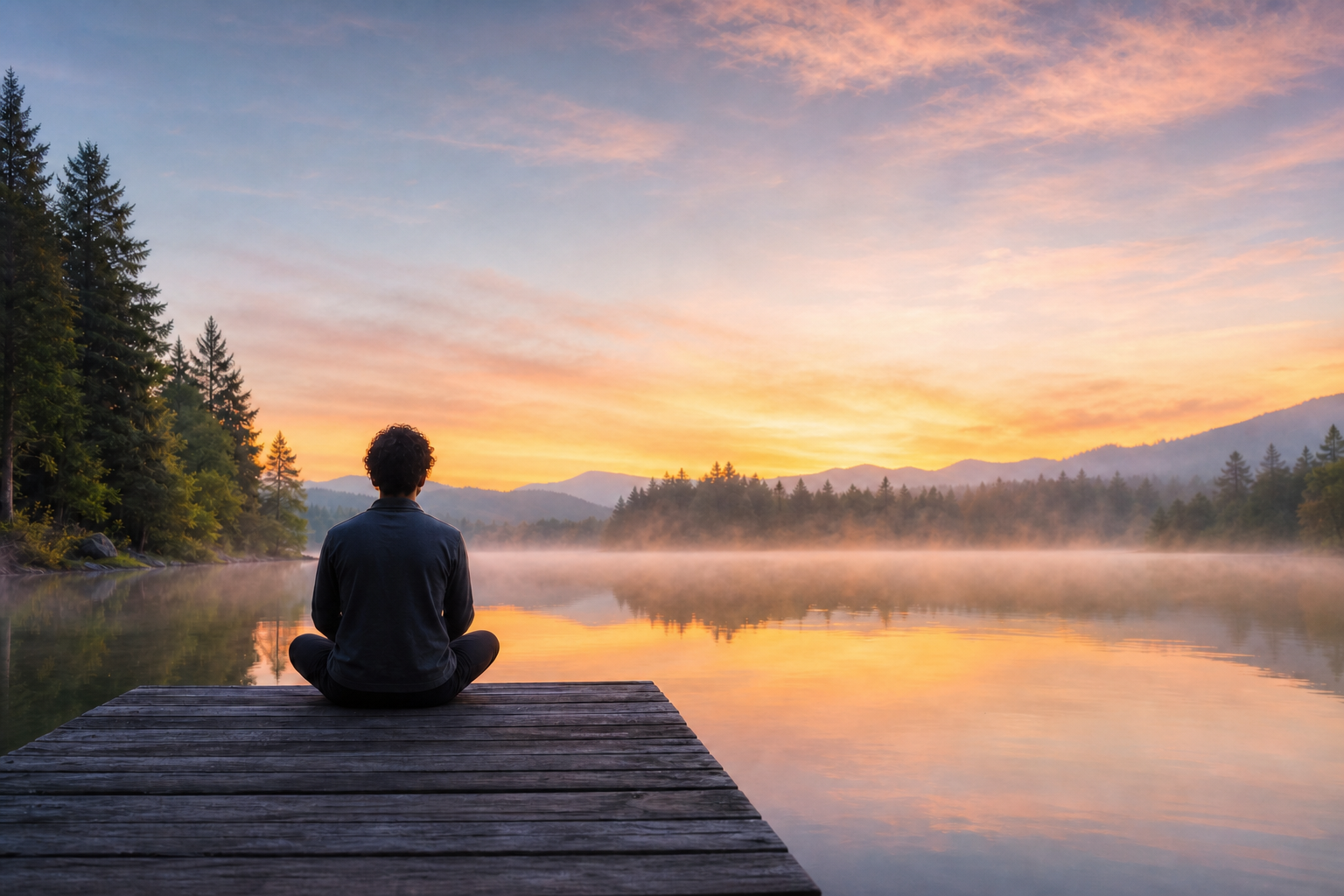
- Inner peace is not a mental state you force, but a physiological state you allow. You can’t “think your way to peace”—true peace arises when the nervous system is given the chance to relax.
- Stress and inner peace are not opposites that you need to balance—it’s a matter of recovery. Chronic stress increases cortisol; structured deep rest (such as during TM) demonstrably lowers it, by an average of 30% after a single session.
- Mindfulness and inner peace are often used interchangeably, but they are not the same. Mindfulness is an attitude of attention to the present moment; inner peace is a deeper level of calm that may precede or result from it.
- Relaxation on its own is not always enough. Sitting on the couch or watching TV shows provides temporary relief, but does little to address underlying tension—the body remains active; only the focus shifts.
- You build mental balance through repetition, not through a one-time intervention. Just as physical fitness is built through regular training, inner peace is built through a daily, consistent practice.
- The most effective techniques do not require concentration. Research on Transcendental Meditation shows that techniques that allow the mind to settle without active direction (“self-transcending” techniques) lead to deeper peace than concentration- or control-based methods.
- Inner peace can be learned, no matter how busy your mind is right now. It is not an innate trait or personality characteristic—it is a skill that is accessible to everyone with the right, personally taught technique.
These insights are based on research into Transcendental Meditation: over 800 studies at more than 200 universities worldwide.
Curious to experience it for yourself? Attend a free, no-obligation introductory lecture: https://www.tm.nl/lezingen
Find a teacher
Contact a local certified TM teacher to learn more about the TM course and the many benefits of TM practice.
Find a teacher near you