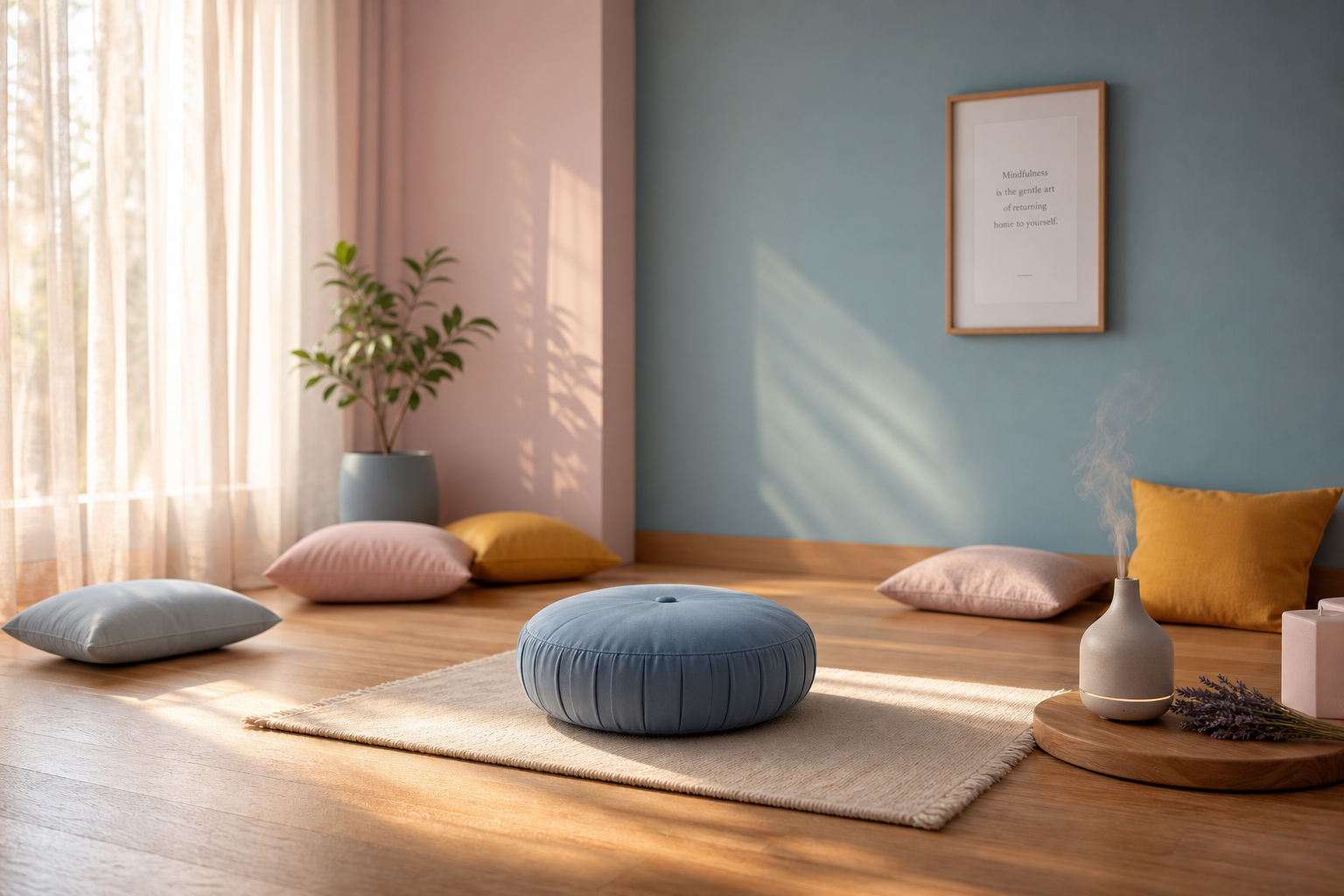
You decide to start meditating because you want to feel calmer. But after a few attempts, you actually feel more restless: your mind keeps racing, you wonder if you’re doing it right, and after a few weeks, you just stop using the app. Sound familiar? You’re not alone—and it’s rarely your fault. It’s almost always a matter of technique. Here are the nine most common reasons why meditation doesn’t feel relaxing for beginners—and what actually works.
1. They try to stop their thoughts
The most common misconception about meditation is that you have to clear your mind. Anyone who actively tries not to think soon discovers that this actually leads to more mental activity, not less—you’re fighting against something that happens naturally. In Transcendental Meditation (TM), thoughts are simply part of the process. Nothing is expected of you in terms of concentration or control.
2. They expect immediate results
Deep calm builds up with regular practice, not after a single session. Anyone who doesn’t experience miracles after the first or second time gets disappointed and quits—just when the effect is starting to build.
3. They force concentration
Many popular techniques require you to focus on your breath or observe your thoughts. Concentration takes energy—the opposite of relaxation. TM uses a silent, effortless mantra that requires no focus or willpower.
4. They learn through an app without correction
An app or video cannot correct mistakes. Small deviations in how you apply the technique go unnoticed and accumulate, preventing you from seeing results without you knowing why. Personal instruction solves this immediately.
5. They meditate inconsistently
The calming effect of meditation is cumulative: it builds up through regular practice. Meditating sporadically—a few days on, then weeks off—never gives the nervous system a chance to truly settle into a state of rest.
6. They choose a method that’s too complicated
Elaborate visualizations, breathing techniques, or complex rituals sound impressive, but in practice, they’re difficult to maintain on a daily basis. The simpler and more effortless the technique, the more likely you are to stick with it.
7. They compare themselves to others
The idea of a completely “empty mind” during meditation is a myth that mainly creates pressure. Everyone experiences meditation differently, and that’s exactly how it should be—it’s a natural, individual process, not a performance to be perfected.
8. They give up at the first setback
Without guidance, a day when it “doesn’t work” can quickly feel like proof that meditation isn’t for you. With personal guidance—such as the free, lifetime check-ins with a TM teacher—you’ll learn that this is completely normal, and you’ll keep going instead of giving up.
9. They underestimate the importance of personal instruction
This is perhaps the most important reason of all: self-taught techniques have a much higher dropout rate than those taught in person. A teacher who tailors the technique to you, corrects mistakes, and answers questions is the biggest predictor of whether a meditation habit will actually stick.
Why TM Takes a Different Approach
Transcendental Meditation is taught in person over four short sessions by a certified teacher, uses an effortless mantra instead of concentration, and is one of the most extensively researched meditation techniques in the world: more than 400 independent studies at over 200 universities. A meta-analysis of 146 studies showed that TM is more than twice as effective at reducing anxiety as other relaxation techniques, and TM lowers the stress hormone cortisol by an average of 30%.
Curious to see how it might work for you? Book a free, no-obligation introductory session with a certified teacher near you.
Find a teacher
Contact a local certified TM teacher to learn more about the TM course and the many benefits of TM practice.
Find a teacher near you